UNI 11339:2023
Esperto Gestione Energia
EGE


Ing. Francesco Madaro – Ingegnere iscritto all’Ordine degli Ingegneri della Provincia di Lecce
Esperto in Gestione dell' Energia - EGE (Certificato Accredia UNI 11339:2023)
Innovation Manager (Certicato Accredia UNI 11814:2021)
Lead Auditor ISO Qualifiche rinosciute da Accredia
Esperto in Innovazione Teconologica Albo MIMIT
Manager dell'innovazione Elenco Unioncamere
© 2026 Madaro Global — Tutti i diritti riservati


LOCAL AI.
CONTROL.
PRIVACY.
OWNERSHIP.
Artificial Intelligence:
If you control it, you use,
if you do not control it, it uses you.

What it means.
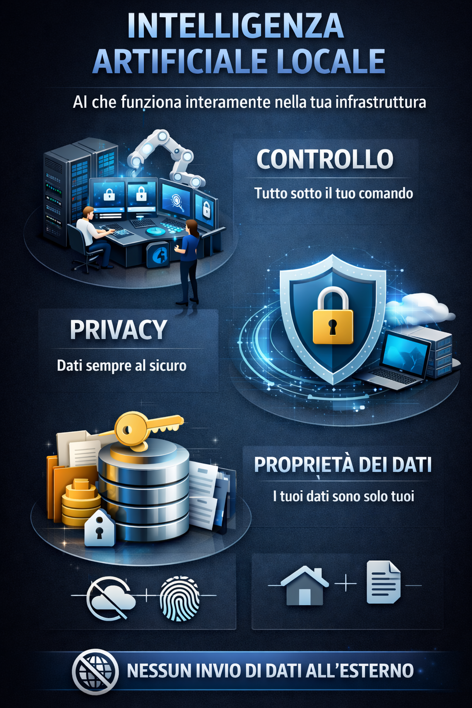
Local artificial intelligence is an AI approach designed to operate entirely within the client’s own infrastructure, with no reliance on the cloud and no data transfers outside the organization. It is an architectural choice that places control, confidentiality, and process governance at the center, making AI a reliable tool for professional and sensitive environments.
1. Control and clearly defined operational boundaries.
2. No data sent outside and protection of confidentiality
3. Data ownership and process governance
A local AI system works exclusively on documents and data that are explicitly defined as relevant. The boundaries are clear and intentional: the AI can access only what it has been authorized to access and operates according to precise rules. There are no implicit accesses, external datasets, or uncontrolled behaviors. Every process is configurable, traceable, and verifiable, ensuring that full operational and decision-making control remains with the organization.
All data remains within the client’s systems—on company servers, local infrastructure, or offline environments. No information is sent to cloud platforms, third-party services, or external providers. This guarantees maximum confidentiality, reduces exposure risks, and ensures compliance with regulatory, contractual, and professional requirements. Sensitive information never leaves the defined perimeter.
With local artificial intelligence, data always remains the full property of the client, as does control over workflows and AI-generated outputs. The system is not a “black box,” but a transparent, auditable, and governable tool. AI supports processes without replacing human responsibility, delivering reliable and repeatable results within a framework of total autonomy and control.